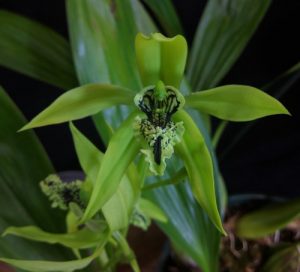
Anyone who reads this column regularly will realise that the author has a bit of a soft spot for Coelogyne. I can’t deny it – I love them. This month’s article showcases a species that it has taken me some considerable time to track down, at least at a price I was willing to pay. It came from one of my trusty contacts in Germany, and was a nice-sized plant. Also, it was clearly a division, rather than a seedling, so I (rightly) assumed it might bloom earlier.
Before we get too far in, I should point out that there are a few imposters out there. Many plants being sold as C. pandurata are in fact the hybrid C. Burfordiense (a lovely plant in its own right) which is a hybrid using Coelogyne asperata as the pod parent. Coelogyne Burfordiense can get to very large proportions, and its size and habit will give it away. There are a couple of other species which have similar (though usually smaller) flowers, those being C. parishii and C. brachyptera. The flowers are superficially similar, but the habit of the plants is quite different and both are considerably smaller than C. pandurata. Still – beware of imposters!
Coelogyne pandurata is found in Malaysia, Borneo, Sumatra and the Philippines, and requires year-round warm or hot conditions to thrive. It enjoys high humidity in its native range, but seems quite happy at the somewhat lower humidities of my growroom (I have to control humidity quite carefully because it can encourage fungal and bacterial problems). It also requires quite a lot of water, and does not appear to have a rest phase as such, but launches into new growth once a pseudobulb has been completed. The plant needs very high light levels to produce blooms regularly (think Cattleya levels). Plants in less bright light will grow beautifully, but fail to bloom.
When you see the picture of the flower below, you will probably wonder why more people do not grow this species. The truth of the matter is that while the flowers are utterly delectable, the plant itself is rather badly behaved. For some of the orchids I describe as ‘badly behaved’, I might mean that they don’t grow well in some way, or that they are prone to getting various pests and diseases. It is rather the opposite with Coelogyne pandurata. It grows fast, and has long lengths of rhizome between its pseudobulbs, meaning it quickly outgrows its containers. The pseudobulbs are rather round in one aspect, flattened in the other, and are topped by a pair of stiff leaves of around 15cm or more in length. While not the size of C. Green Dragon or C. asperata, the plant is still large, and wanders far more than either of the above. I am experimenting with planting offshoots (yes, it is producing offshoots already) at the edge of a large pot and training the new shoots round the outside. The shoots are not easy to direct in any way you might want them to grow, and the rhizome can be rather brittle and will snap if you are too rough with it. Luckily, if a break does occur, the plant will re-sprout readily and you end up with a new plant to pass on in future. Root growth is vigorous and occurs in two flushes from the main rhizome at almost any time, and also from the base of the newly completed pseudobulb.
The flowers are produced from new growth while it is still very young. Spikes tend towards the upright, but those with more flowers will arch a little. Flowers are reputed to be quite fragrant, but I haven’t noticed this on my plant. The blooms themselves are a gorgeous green with bold black marks on the lip. The colour combination rather reminds me of those old-fashioned chocolate lime sweets, and is very striking indeed.